PUBLISHED
September 4, 2025
7 minutes read
How do we save fashion heritage from decay?
As she prepares for a SYKY Design Hour masterclass, d_archive co-founder and director Martina Ponzoni speaks on how 3D technologies can shift fashion heritage from fragile conservation toward radical re-display.
Words by Asya Sumik
Can rapidly fading pieces of fashion history be seen in ways that go beyond the glass cases of museums? d_archive supports the preservation of fashion heritage by making it accessible digitally. Co-founded by 3D specialists with extensive experience in fashion design and development — Virgile Biosa, Erisa Ibrahimi, Martina Ponzoni and Daniele Scarante — the team wanted to preserve fragile garments in a way that lasts beyond the physical piece.
Historical garments are constantly deteriorating: silk breaks down, latex corrodes, polyester yellows. Museums can slow this process through climate control, reduced light exposure, and strict handling protocols, but these measures only delay the inevitable. Moreover, restoration often causes more harm than good. It is often difficult to restore the original appearance of historical clothes, and direct repair means may cause secondary damage. Physical protection methods can only slow down the aging process, which cannot preserve clothing relics permanently. Therefore, restoring and preserving heritage clothing is a highly urgent task.
Can 3D solve this problem? Yes, and moreover, it provides a new layer of information, interaction, and accessibility. Digital methods are emerging as meaningful tools to document, restore and reconstruct heritage garments that would otherwise disappear.
The d_archive team collaborates with institutions such as MoMu, Museum Boijmans Van Beuningen, and ATOPOS to uncover and digitize selected pieces. As Ponzoni explains: “3D replicas should never be seen as replacements of the original, but as an additional collection of information and data about a piece that can be used in different and new ways.”
We spoke with Ponzoni about the shift in how digital products are valued, the research d_archive conducts to identify historical garments, and the mission of the platform: to preserve fashion heritage for the future.
Let’s start from the beginning. What led to founding d_archive, and why did you choose 3D as the medium to preserve fashion’s heritage?
d_archive began as a collective effort of four people: Virgile Biosa, Erisa Ibrahimi, Martina Ponzoni and Daniele Scarante, each with a background and extensive experience in 3D fashion design and development. We met over the last 10-12 years and worked together on various projects. Towards the end of 2022, we discovered that we all shared an interest in a field where the use of 3D technologies is still relatively immature: fashion and costume archives. We therefore decided to found d_archive and use our specialist knowledge of 3D fashion design to develop a method that allows fashion items to be studied from a technical point of view, thus adding a new “layer” of information available on archive garments.
On your platform, anyone can access patterns for some of the most iconic garments in fashion history — from the 18th-century Bamboo Motif Hanten to the Levi Strauss Denim Pantalon, recreated from Jacob W. Davis’s original 1878 patent sketch, with no physical examples ever found. What does it mean, in practice, for a designer or student to work with these files?
By offering 3D replicas rich in context and technical information, we hope to provide the best option for investigating fashion objects, second only to the [often unavailable] hands-on experience. Working with the files we openly share, students and designers can gain insights about the pattern making and garment construction aspects of a piece, and hopefully be inspired by them for their future practice. They can also reinterpret these patterns and use them as a starting point for their own design, either physical or digital-only. The concept of “playing” is usually very distant from pieces collected by museums and fashion archives. However, through digital means one can remove the risk of damaging the item and feel free to study, explore, deconstruct and reshape objects that are usually only available to be seen behind glass, or gently handled with gloves in specific settings.
You’ve built strong relationships with institutions such as MoMu, Museum Boijmans Van Beuningen and ATOPOS. What research goes into uncovering and selecting garments, and how do you get access to these archives?
I think what we share with people that work for these institutions is a communal interest and vision regarding the publication of open-source educational material surrounding fashion history and pattern making techniques and, in general, making archival fashion more accessible. Because of this synergy, I suppose we were able to access their archives and develop some very interesting projects together.
We always rely on the knowledge and experience of curators to select pieces that would be interesting to digitise, for one reason or another: their fragility, their uniqueness or… their absence, like in the case of the Maria Sethe gown we created for the exhibition Fashion & Interiors. A Gendered Affair.
Pattern making has centuries of history behind it. How does the way it was done then differ from now, and why does that matter when you’re rebuilding pieces digitally?
The difference is only in the tools, using paper vs. a screen, but the logic behind the pattern making itself remains the same. One should consider the body wearing a garment, as well as the materials employed and construction techniques used to make it. I would say new techniques have emerged since pattern makers started working with CAD software more than twenty years ago, and more are emerging now that we also have a three-dimensional component to it. What we try to keep in mind is always that we are working with physical garments. Even if we work with software, our knowledge about pattern making, fabric behaviour and garment construction IRL is essential to translate it and find solutions that work well digitally, without compromising the integrity of a piece.
“Even if we work with software, our knowledge about pattern making, fabric behaviour and garment construction IRL is essential to translate it and find solutions that work well digitally, without compromising the integrity of a piece.”
What was the first historical garment you recreated in 3D, and what did the process teach you?
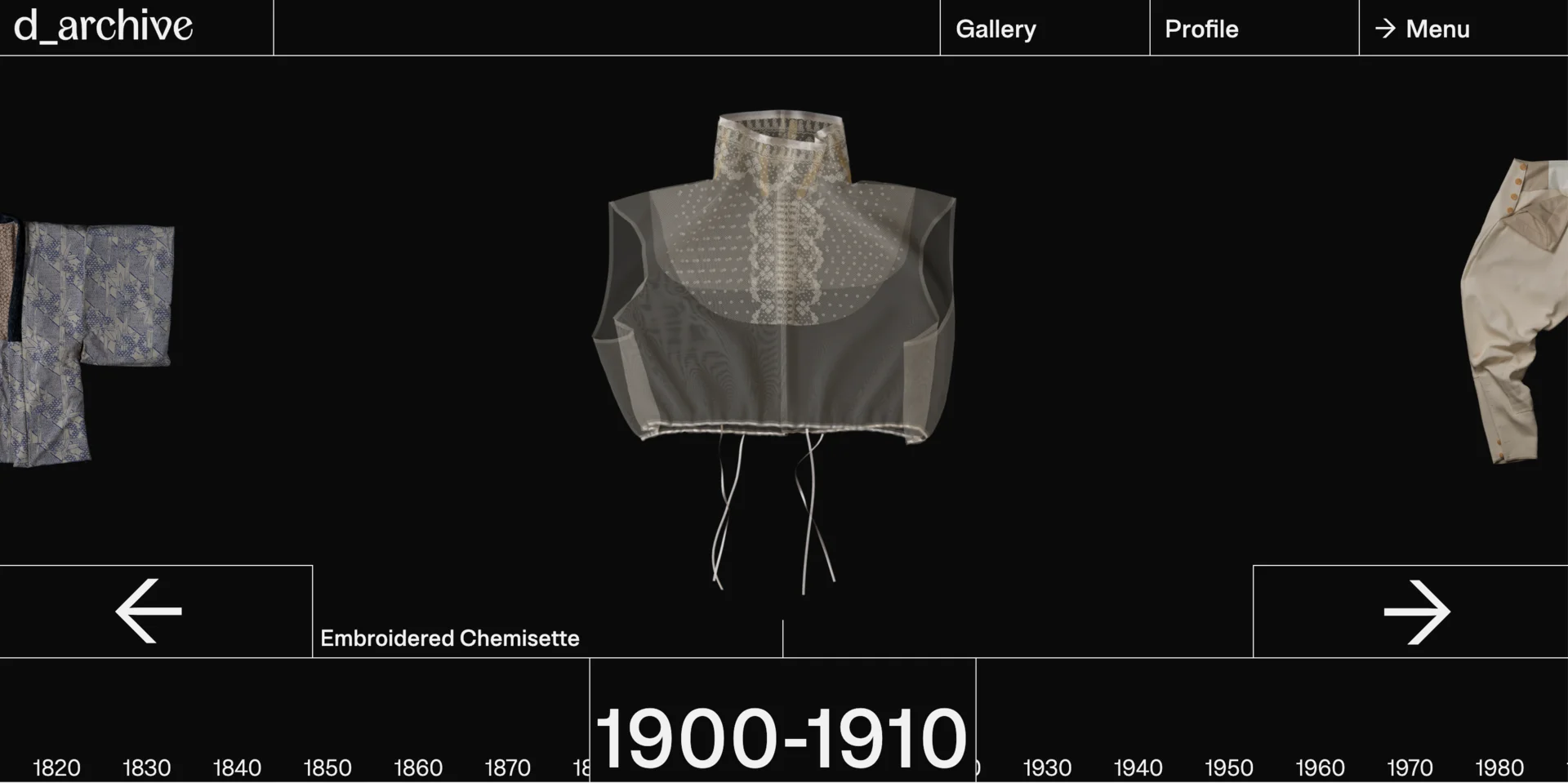
One of the very first pieces we digitised was this early 20th-century embroidered chemisette from the MoMu Study Collection. While reverse-engineering it, we realised that the armholes shape are asymmetrical and weirdly shaped, and the collar is cut in a straight rectangular piece — which makes it quite uncomfortable to wear, since it doesn’t follow the natural shape of a neck, but was probably constructed in that way to accommodate the embroidery workmanship. Because of this and other instances, we realised we had to always second guess our assumptions about patterns, and should consult with curators and conservation departments for more insights. Before starting d_archive, we worked for ten years with many brands and designers, and grew accustomed to industrialised pattern making. Considering that software we use has been developed for industrialised garments, we learnt (and are still learning) how to adapt these 3D tools to garments that were manufactured very differently from how they are today.
You recently presented a 3D replica of The Bee, a latex piece that decays rapidly and can’t be exhibited for long periods. Do you see projects like The Bee as a way to shift public perception — from valuing only the physical garment to also valuing its digital afterlife?
I really hope so! I think 3D replicas can be very useful to fashion heritage conservation and accessibility, in the right context. From my perspective they should never be seen as replacements of the original, but as an additional collection of information and data about a piece that can be used in different and new ways.
What are the challenges in recreating historical fashion pieces, and what solutions have you found along the way?
Some pieces are so fragile that going through the reverse-engineering process can be quite challenging; handling and measuring a damaged or deformed piece requires a lot of attention and work. As I mentioned before, the pattern making process also needs to be based on historical information, to avoid inaccuracies and anachronisms. Lastly, we are not allowed to scan and test the actual fabric, we need to recreate its textures and physical properties manually, which relies a lot on our professional knowledge of fabrics, and also on the recommendations and suggestions of textile conservators.
Finally, what’s next? Are there any projects we should look out for?
We are working and talking with many different institutions; some projects are already in progress (no spoilers, sorry!) and some others need funding we are hoping to find soon.
Thank you!! :)